Tripnomics – “The Economics of a trip”; by TravelSpends is a platform that can be deployed for real time air fare validation or hotel rate review. Tripnomics is delivered on a SaaS (software-as-a-service) model. We also support multi-instance deployment optionally. It is domain-engineered around set of core capabilities that can be deployed individually or in bundles to service any workflow in our business solution.
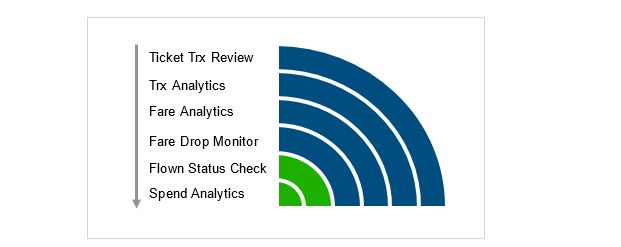
The following describes the workflow in Tripnomics:
1. Travel Policy of the enterprise is captured in Tripnomics
2. Enterprise authorized TMC GDS and TravelSpends GDS needs to be bridged.
3. The ticketed itinerary is reviewed & analyzed to understand the travel itinerary.
4. Alternate options are checked for acceptance within client specified parameters
5. The ticketed itinerary is monitored for fare-drop until the day of travel.
6. Every itinerary is checked immediately after the date of travel for flown status.
7. Data is aggregated and visualized for reporting and analysis of spends.
Inventory Distribution in Travel for airlines and hotels is based on software-driven platforms also known as global distribution systems (GDS) developed and maintained by providers such as TravelPort, Sabre, Amadeus.
The on-going changes in the travel ecosystem make it mandatory for the enterprise to have access to independent, neutral third-party platforms like Tripnomics that offer feature parity and more importantly an independent validation of the TMC fare/rate offerings and delivery mechanism. It is in response to a dynamic, non-transparent industry offering that the enterprise expects and needs ‘real-time’ travel analytics solutions.
In order to address these challenges, Tripnomics performs the below routines:
1. Monitor “Queue’s” within the GDS and import them into Tripnomics
2. Retrieve “PNR’s” s from a designated GDS queue and update Tripnomics
3. Check for alternate itinerary within defined Enterprise parameters
4. Finalization of alternate flight itinerary and fare conditions along with reason codes
5. Confirm the status of the transaction as “compliant” or “non-compliant”
6. Communicate the status and potential savings opportunity to the designated TMC.
In-order to achieve the above it is essential that the TMC GDS is bridged with the TravelSpends GDS. Kindly refer to the details and work-flow mentioned under “Bridging TMC GDS”.
Introduction
Contract
Confirmation
| Fields | Category | Read | Write | Both | None |
|---|---|---|---|---|---|
| PNO | Receiver can Retrieve Individual PNR's by All Methods | ||||
| PNN | Receiver can Retrieve Individual PNR's by Recloc | ||||
| PNG | Receiver can Retrieve Group PNR's by All Methods | ||||
| PNL | Receiver can Retrieve Group PNR's by Recloc | ||||
| RMO | Receiver can Allow Remote Sign In(Cannot be Read or Write can be only Both) | ||||
| DCB | Ticketing(Receiver can access TWD record and ITR)(Recommended READ MODE ONLY) | ||||
| DEM | Ticketing(Receiver can access EMD record)(Recommended READ MODE ONLY) | ||||
| SRP | Receiver can Access Sales Report(Recommended READ MODE ONLY) | ||||
| QUE | Receiver can access Queue bank | ||||
| CPR | Receiver can access Customer Profiles |